La La Land: How Linus Sandgren Made a Modern Musical Feel Like 1955
Custom anamorphic glass, a pulled negative and dance numbers shot to feel like single takes — the engineering behind the film's throwback look.

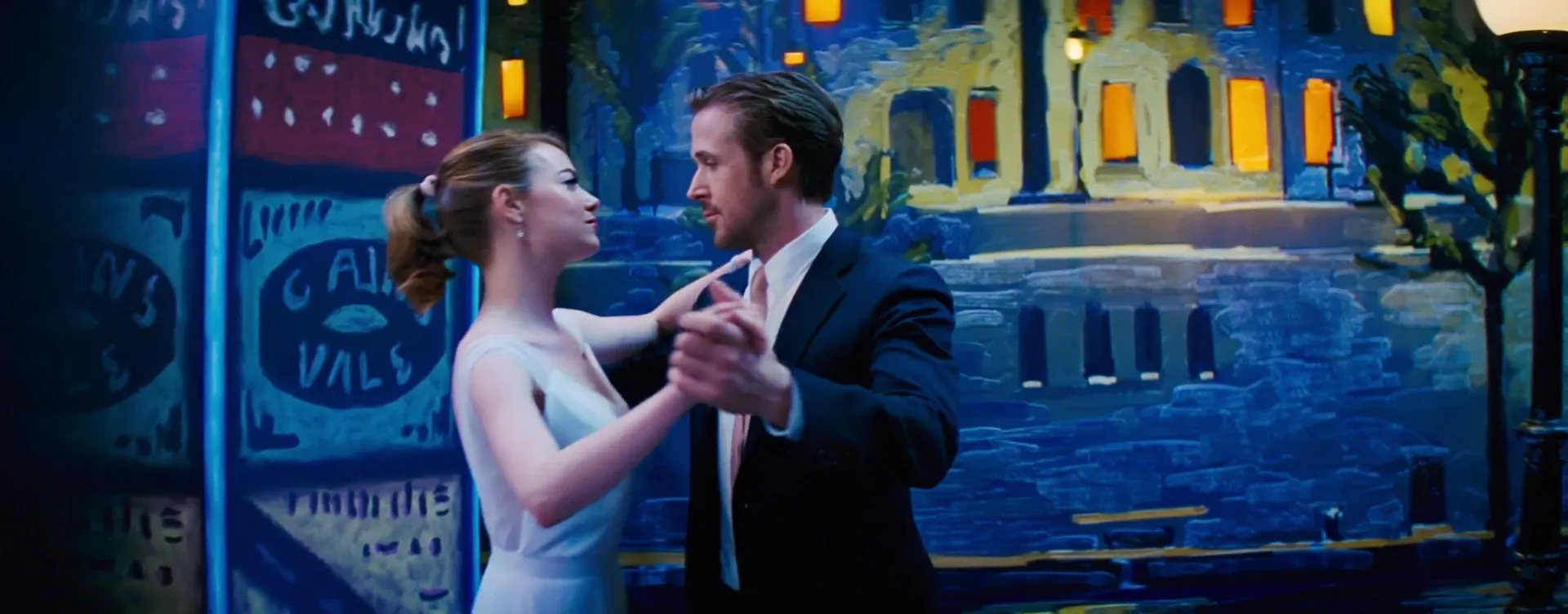
Nobody shoots 2.55:1 anymore. That ultra-wide CinemaScope frame basically died with the old studio musicals, which is exactly why Damien Chazelle went hunting for it. He wanted La La Land to look like it fell out of a 1955 MGM release print — not with a nostalgia LUT dropped on in the grade, but with the look built into the negative. Getting there fell to Linus Sandgren, and what makes the La La Land cinematography worth studying isn't the throwback vibe. It's that almost every romantic-looking choice was a hard technical decision made on set, on film, with no undo button. It won Sandgren the Academy Award for Best Cinematography, one of six Oscars the film took at the 2017 ceremony.
The format that shouldn't still exist
Sandgren shot La La Land on celluloid — 4-perf Super 35mm — with Panavision Panaflex XL2 cameras and anamorphic C- and E-series primes. Not a retro affectation. He and Chazelle both wanted the specific way film holds saturated color, the way an emulsion rolls off in the highlights instead of clipping hard the way a sensor does. Sandgren has been blunt about it: digital captures reality so cleanly that it's hard to make anything look magical. A musical needs magic.
The bigger swing was the aspect ratio. Modern scope is 2.40:1. The old CinemaScope musicals were wider — 2.55:1 — and that's the frame Chazelle asked for. Almost nobody's glass covers that width anymore, so the format itself became a lens problem before a single frame rolled.
They also pulled the negative — under-developing it in the lab — to hold the pastel, slightly faded palette Chazelle wanted. Sandgren has pointed out that the pull lives physically in the negative; it isn't a grade you could dial in afterward. That's the whole philosophy of this shoot in one decision: commit on set, live with it. Sandgren walked through the whole approach in detail if you want it straight from the DP.
Rebuilding lenses to shoot like it's 1955
Wanting 2.55:1 is easy. Covering it is not. Panavision had to rework lenses to throw a wider image than the standard 2.40:1 anamorphic circle, and individual optics got modified for specific shots. The clearest example: a normal 40mm anamorphic focuses no closer than about three feet, which is useless if you want to drift off a hand or a face and pull back into a wide two-shot in one move. Dan Sasaki at Panavision swapped elements to bring that same 40mm's close focus down to roughly nineteen inches.
That kind of surgery is why the camera can sit intimate and then breathe out to the whole set without a cut. If you've ever wrestled with how focal length, distance, and aperture all fight each other the moment you want both a close subject and a deep background, the trade-offs behind depth of field are exactly the corner Sandgren was engineering his way out of. They even built a custom 18mm anamorphic for the 16mm home-movie flashback footage, so even the deliberately cheap, nostalgic texture was its own bespoke piece of glass.
The long takes that actually earn the risk
The opening — "Another Day of Sun," the traffic-jam dance on a freeway ramp — plays as one unbroken take. It isn't. It's built from a handful of shots hidden inside whip-pans so the seams disappear in motion. But the illusion of continuity is the point: the camera never lets you off the ramp, so the number never breaks its own spell. They shot it on a real interchange connecting two Los Angeles freeways, the crane gliding over car roofs.
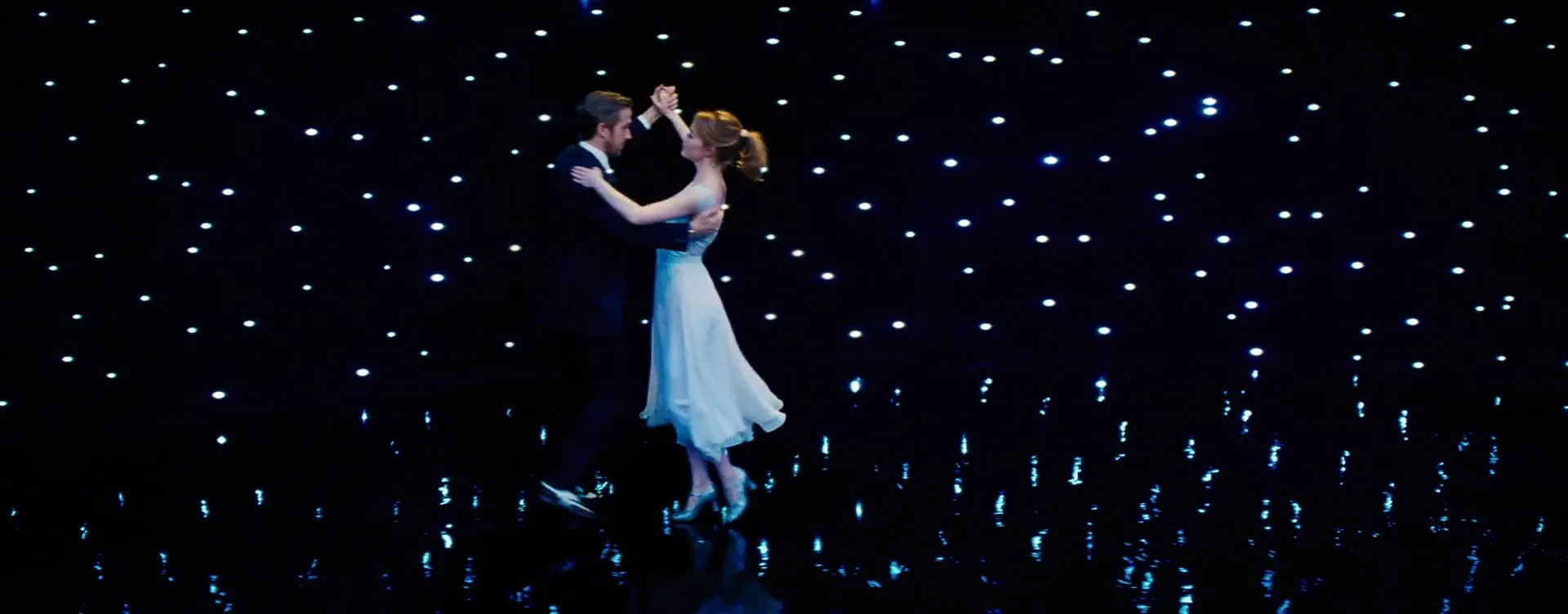
The "A Lovely Night" number on the dusk hillside shows how thin the margin really is. Magic hour gives you maybe twenty usable minutes a night. The crew rehearsed all day, hit 27 marks on the crane, and got only a few clean takes across two evenings before the light was gone — Chazelle picked the keeper from those. The planetarium dance, where the couple floats up into the stars, was a stage build — actors on wires against a projected star field — but it's cut with the same logic: hold the shot, let the movement do the talking.
Long takes like these live or die on preparation, not luck. The same is true of the impossible-looking oner in Children of Men — the magic is almost entirely in the engineering.
What the La La Land cinematography does with color
This is where the film earns its reputation. The palette isn't just pretty — it tracks the story. Sandgren has described letting color shift with the emotional arc: cool cyans and deep blues for the romantic, dreamlike beats, warmer oranges when reality creeps back in. The primaries are pushed hard and used as bookmarks, so a wash of light or a costume tells you where you are emotionally before a line of dialogue does.

Look at how a single frame holds a saturated blue against a warm amber and refuses to let either win. It's the complementary-color logic of the old Technicolor musicals, done with real light on real sets instead of in post.

Using color and physical space to carry meaning is a discipline of its own — Parasite builds its entire class metaphor out of it — but La La Land is the brighter, more romantic end of the same idea: the frame is doing emotional work every second it's on screen.
The takeaway for your own shoot
You're probably not modifying anamorphic glass or shutting down a freeway. The transferable lesson is smaller and more useful: every one of these choices was locked before the camera rolled, because film and long takes don't forgive indecision. The format, the palette, the exact path of each crane move — all decided in prep, so the shoot day was execution instead of discovery.
That's the case for nailing down your visual language before you're on the clock. Pulling references for a look this specific — the color relationships, the framing, the movement — is exactly what a visual reference library wired straight into your shotlist is for: you decide what the frame is supposed to feel like while you still have time to change your mind, then walk on set and shoot it.
How did you like this article?
Login to react to this article
Discussion (0)
💬 No comments yet. Be the first to share your thoughts!