Parasite Cinematography: Shooting Class as Vertical Space
Hong Kyung-pyo never lets a rich character and a poor one share an eye level — and once you notice the rule, the whole film reorganizes itself.

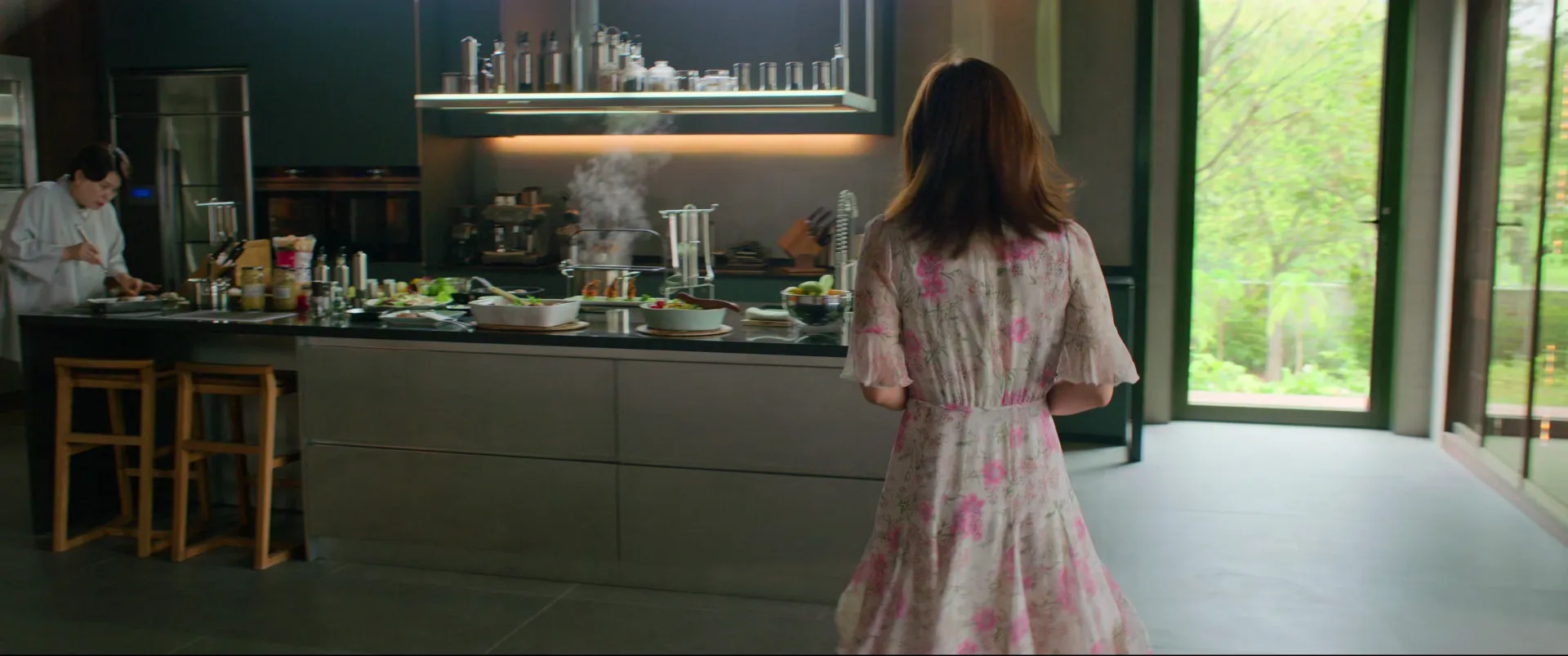
The Kim family lives at the bottom of a window. The Park family lives at the top of a hill. Parasite spends a little over two hours moving people between those two altitudes, and it never once stops to explain the class divide — because Bong Joon-ho and cinematographer Hong Kyung-pyo already built the argument into the geometry of every frame. You just keep looking up, or looking down, and after a while your body knows who is winning. That is Parasite cinematography in a sentence: height is the story, and the camera never stops making it.
It's worth studying as a craft problem rather than a think-piece. Hong — who also shot Burning, Snowpiercer, and Mother — treats vertical space as a diagram of who has power and who doesn't. Working on the ARRI Alexa 65 with Angénieux zooms in a 2.35:1 frame, he had a wide, deep canvas to play with, and he spends nearly all of it on altitude.
Camera height is a character's address
Hong has said the people in Parasite have different eye levels depending on where they are, and that their whole view of the world is limited by exactly that. It sounds abstract until you watch where he puts the lens. In the Kims' semi-basement — a banjiha, the half-underground flats common in Seoul for their cheap rent — the camera sits low and looks up toward the street-level window, where a drunk stranger stops to urinate and a fumigation truck gasses the room. The Kims are, literally, below the line of ordinary life, looking up at a world that doesn't know they exist.
Move to the Park house and the camera stands up. It rises to a comfortable adult eye level, tracks sideways across wide clean rooms, and looks out — through a wall of glass at a manicured lawn. Same film, opposite posture.
Notice there's no dramatic angle doing the work here. The wealth reads as ease: horizontal moves, headroom, a lens that can breathe. Hong lights it with soft, warm, indirect sources so the room feels expensive and calm. The semi-basement gets the opposite — greenish fluorescents and bare tungsten bulbs that flatten faces and add ten years. The grade alone tells you the rent.
Every staircase is a verdict
If height is the film's grammar, the staircase is its punctuation. Parasite is full of stairs, and almost none of them are neutral. People climb when their fortunes rise and drop when they collapse, and Hong stages the movement so you feel the gradient in your legs.
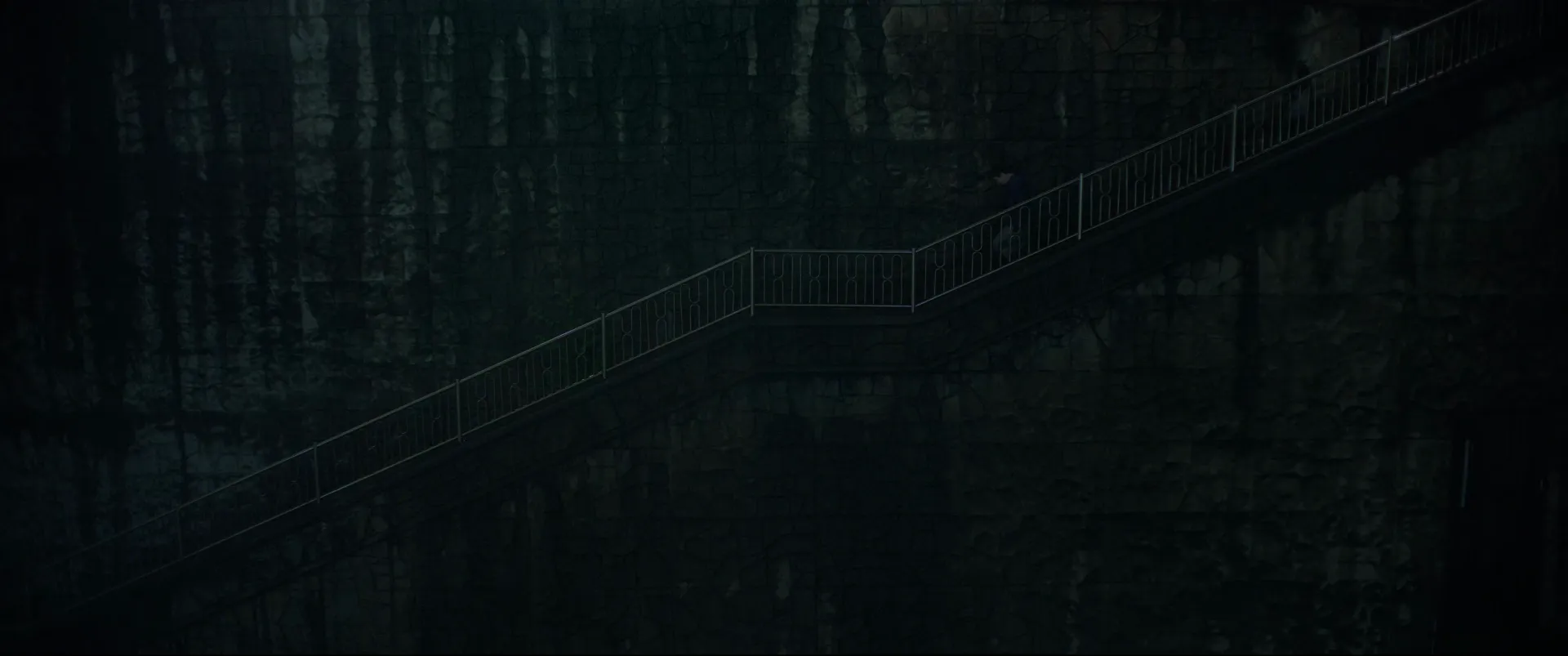
This is the vertical logic critics keep tracing back to Kurosawa's High and Low — the rich man literally on the hill, everyone else in the sprawl beneath him. Bong runs the same idea but adds floors. The clearest beat lands in the storm: once the Kims are driven out of the mansion, they descend, and descend, and descend — flight after flight from the wealthy heights down into their flooding neighborhood, shot far enough back that the family shrinks to specks. One continuous downhill. No line of dialogue could do that as cleanly as a wide lens and a lot of steps.
There's always a lower floor
The cruelest move in the whole design is that the semi-basement isn't the bottom. Under the Parks' beautiful house sits a bunker the owners don't even know exists, and someone is living in it — a level below the level, lit sick green with a single red emergency glow.
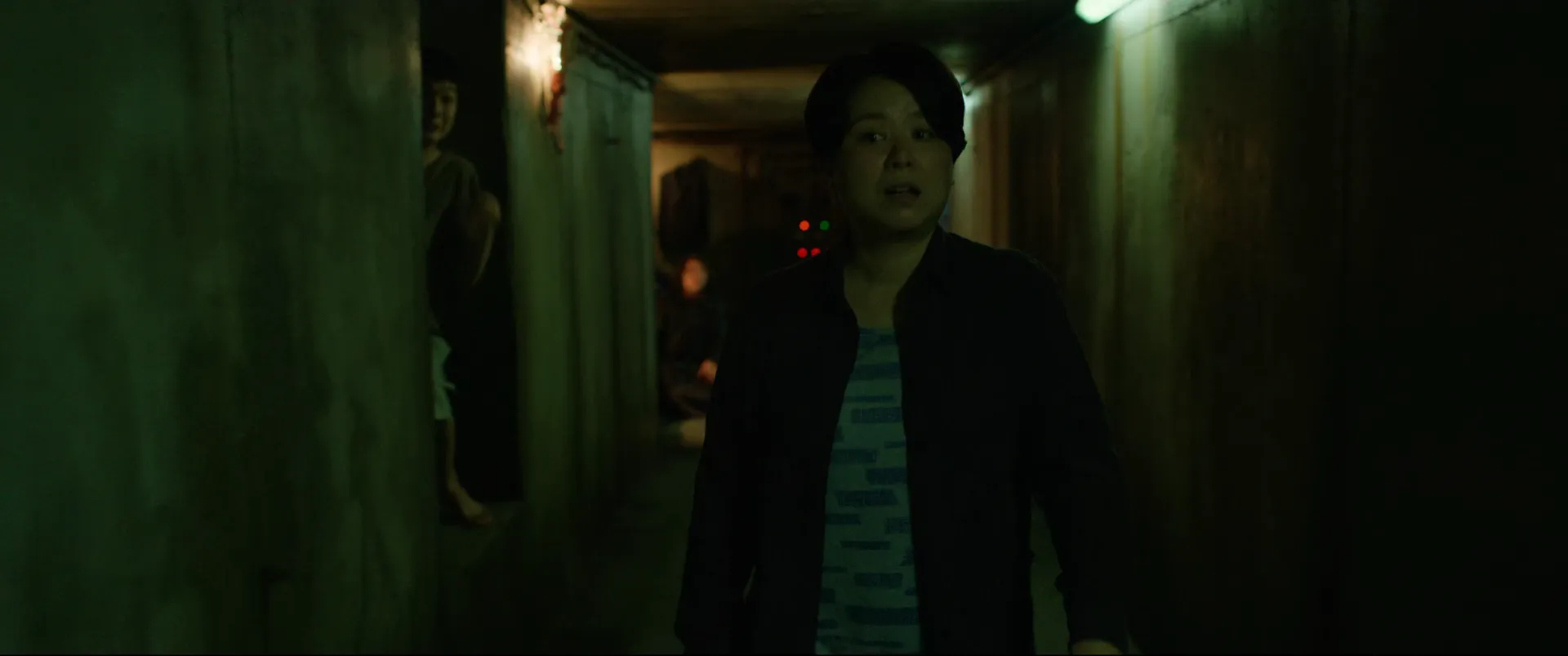
Hong shoots this space like a wound in the architecture: narrow, pressing, no horizon, no window, nothing to look up at but concrete. It reframes the entire vertical map. The Kims spend the film thinking they're climbing toward the Parks. The bunker reveals a floor beneath even them — proof that the ladder has more rungs going down than up.
That the whole thing holds together spatially is partly production designer Lee Ha-jun's doing. The Park house, the semi-basement, and the street were all purpose-built sets — the poor neighborhood constructed inside a water tank so it could be flooded on cue. The geography is invented, which is precisely why every eye line and sightline lands exactly where Bong wants it.
Windows are for looking, not leaving
Watch how often the two households are framed against glass. The Parks look out at a garden. The Kims look up at a gutter. Same rectangle of light, opposite meaning — one is a view you own, the other is a view you're stuck beneath.
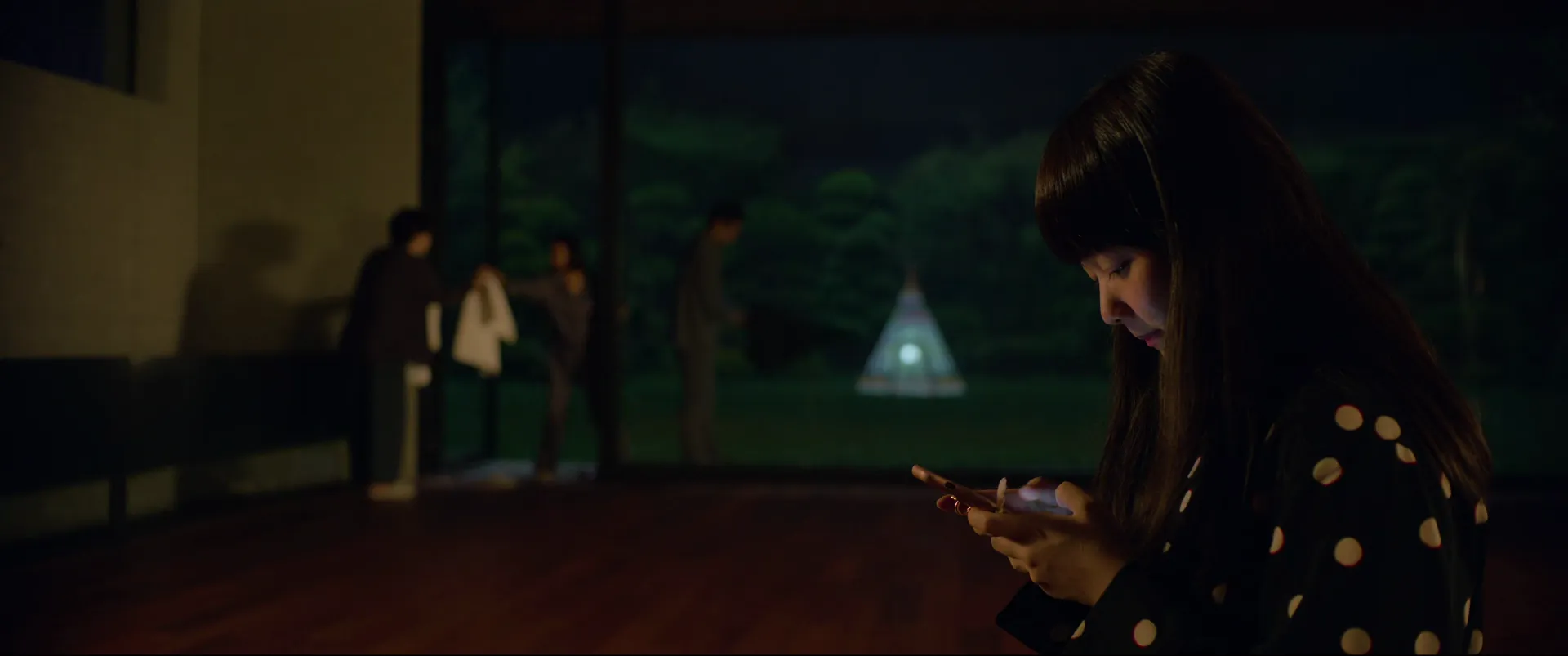
The window is the film's quiet thesis. A view is a kind of wealth. The Parks' picture window turns nature into décor; the Kims' little street-level pane turns the sidewalk into a threat. Hong never editorializes the shot — he just keeps the eye lines honest and lets the geography do the arguing.
The real lesson of Parasite cinematography
The power here isn't a lookbook of pretty frames — it's a rule applied without mercy. Bong and Hong decided height meant power, and then they never broke the rule: every camera position, every stair, every window pays into the same account. That consistency is the part you can actually copy. Pick the one spatial idea that carries your story and let it govern lens height and blocking before anyone starts talking about "the look."
Which is where pulling references early earns its keep. Ahead of a location scout or a blocking rehearsal, build a small board of frames that share your film's spatial logic — the way a wall of Parasite stills makes "up is power" legible to a director, a gaffer, and a first AD in the same glance. That's the whole point of a reference library that lives next to your shotlist instead of in a folder nobody opens: everyone stages against the same geometry. If you're mapping the visual language of your next project, lock the palette and the spatial rules before the camera shows up — and for another single-film breakdown of a DP building a whole look from one hard constraint, see how Kubrick shot Barry Lyndon by candlelight.
How did you like this article?
Login to react to this article
Discussion (0)
💬 No comments yet. Be the first to share your thoughts!