Why StillsLab Now Costs $5 a Month
The full monthly bill, the two business models I turned down, and what changes for free accounts (nothing).

Here is the entire monthly bill for StillsLab. Twenty-five dollars for the server. About a dollar to store the images. Ten to fifteen for the machine that writes a description of every frame. And, as of this month, another forty-three in mandatory social contributions to the Ukrainian state — the standing charge for being a registered business instead of a hobby.
Eighty-something dollars. I'm telling you that before I ask you for five of them, because the honest version of this works better than the dramatic one. Nobody is drowning here. No burn rate, no runway, no investor waiting to be repaid.
Why this is happening now, after eighteen free months
That last line is also the answer.
StillsLab was registered as a sole proprietorship this month. In Ukraine you can't legally take card payments without that, and from the moment you have it the state bills you every quarter whether anybody subscribes or not — about 5,700 hryvnia a quarter, due on schedule, in a good month and a dead one alike. The paperwork and the subscription are the same decision. I couldn't do one without the other, and now that the meter is running, "eventually" stopped being an option.
The bill is small. The trajectory isn't.
The library is 88,473 frames pulled from 463 titles — 314 films, 135 music videos, 14 series. It started in February 2025 and has been growing at roughly five thousand frames a month since, which is the part that matters. Every frame added is a frame that has to be stored, described, indexed, and served forever.
Stored twice, actually. Each frame lives as a web-resolution copy at 1920×1080 for browsing, and as its original — up to 4K — in a private bucket that only feeds downloads. That's the honest reason full-quality downloads sit behind the paid tier: the browsing copy is cheap and the original is not, and the original is the one you put in a lookbook.
Then every one of those frames has to be described, or search doesn't work. Not tagged by hand — described, so that "warm tungsten interior, two people, low angle" finds something real. That's the ten-to-fifteen dollars, and unlike the server it scales with every film added.
Eighteen months in, I've put somewhere around a thousand dollars of my own money into this, and that was before the state started taking its share. It isn't a hardship story. It's just the number, and it's the reason this post exists instead of a banner ad.
Everything a subscription earns past that bill goes back into the library: more films, more frames, described and indexed so they're findable. There is no other line item. No team, no office, no investor expecting a multiple. If this ever makes more than it costs, the difference shows up as titles you can search, which is the only form of profit that's any use to you.
The two ways I'm not going to pay for this
The first is advertising. A reference library is a page whose entire job is to show you a colour accurately, and putting a bright orange banner next to a still is a lie about that still. You'd be judging a grade against a background I sold to someone else. That's not a business-model objection, it's a craft one — the same reason you build a colour palette before you shoot instead of guessing on the day.
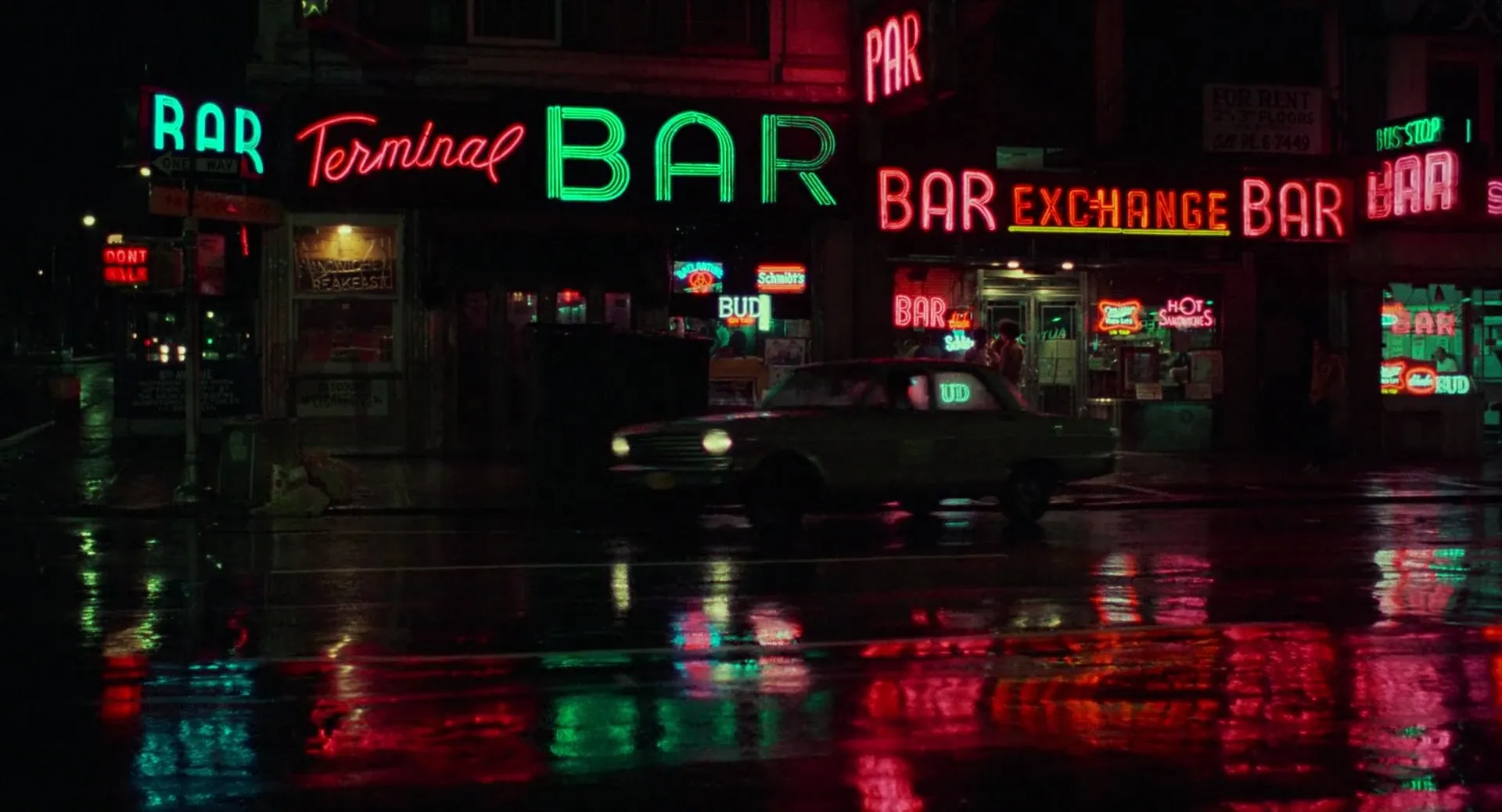
Look at the frame at the top of this page — Scorsese and Michael Chapman's wet neon, where the reds and greens are the shot — and imagine a banner ad sitting next to it. Tell me you're still reading those reds correctly.
The second is selling what you search for. Think about what a search history on this site actually is. Two weeks before a shoot, a director types in a mood, a decade, a film they're stealing from. That's the pitch. Sometimes it's a client who hasn't announced the project. There is a real market for that data and I'm not going to be in it.
Which leaves the third option, which is that the people using it pay for it.
What $5 actually buys
Pro is $5 a month, or $50 for a year. It unlocks the parts of the site that are expensive to run or expensive to build:
- Search that can say no. Exclude terms, AND/OR logic, negative filters. The difference between "night interior" and "night interior, not neon, not handheld" is the difference between 400 results and the 9 you wanted.
- Reverse-image search, unlimited. Drop in a frame from anywhere and find its relatives in the library.
- Full-quality downloads, up to 4K, no daily cap. The originals, not the browsing copies.
- Frame comparison — slider, grid, and side-by-side metadata, for when you're arguing about two candidates for the same beat rather than admiring one.
- Similarity you can tune, so "more like this" can mean the lighting, or the composition, or the palette, instead of whatever the algorithm assumed.
- Priority film requests. If the film you need isn't in the library, Pro requests jump the queue.
- Showcase submissions, so your own work can end up in the library other people search.
If you've ever assembled a director's lookbook that actually sells the vision, you already know which of those saves the most hours.
What stays free
Browsing, searching, and saving to Labs stay free. Standard-resolution downloads stay free, with a daily limit. The reference library itself stays open — you don't hit a wall at frame ten.
I want to be precise about this because "free tier" usually means "demo". This one isn't. If you're a student building a mood board, the free account does that job completely, and submitting your own film to the library costs nothing either.
The comparison I'm not going to hide
You have other options and you'd find them in about a minute, so here they are from me instead.
ShotDeck, founded by cinematographer Lawrence Sher, is the largest library of this kind — over 1.8 million images — and runs $12.95 a month or $100 a year. It's a serious tool and the tagging is excellent. FilmGrab is free, hand-picked, around 4,000 films, and funded by its readers; it's a browsing experience rather than a search engine, with no 4K originals and no comparison tools.
StillsLab is smaller than both. Eighty-eight thousand frames is roughly half of FilmGrab's catalogue and a fraction of ShotDeck's. I'm not going to pretend otherwise.
What's here instead: every frame available at its original resolution, search that handles exclusions and negatives, reverse-image lookup, real frame-to-frame comparison, music videos and series sitting alongside features, and about five thousand new frames a month.
_frames_frame_78.webp)
That one's a music video, and it turns up in the same search as The Lighthouse and Arrival if you ask for a backlit silhouette in fog. Some of the best lighting work being done right now is in three-minute pieces nobody indexes, which is exactly why they're in here.
At $5, this is priced like what it is: a smaller library with sharper tools, run by one person who answers his own email.
Dollars on the page, hryvnia on the card
One thing worth explaining, because it looks odd the first time.
Prices are set in US dollars, but the charge itself goes through in Ukrainian hryvnia, for the reason described further up: the business is Ukrainian and payments run through monobank. The amount is converted at the National Bank of Ukraine rate on the day of each charge. The dollar price doesn't move. The hryvnia figure drifts a little from one period to the next, which is why the checkout shows you exactly what today's charge comes to before you agree to it.
Card details never touch our servers. Cancel any time and access runs to the end of the period you've already paid for.
If the site has saved you an afternoon of hunting for the right frame, Pro is $5 a month and it keeps the lights on. If it hasn't yet, the free account is still there and still free.
How did you like this article?
Login to react to this article
Discussion (0)
💬 No comments yet. Be the first to share your thoughts!