Christopher Doyle: How Wong Kar-wai's DP Made Longing Look Like That
The step-printed blur, the 6.8mm lens, the acid-green tungsten — a working look at the choices behind film's most imitated mood.

Watch the crowd blur past the snack counter in Chungking Express and your eye never quite lands on anyone. Bodies smear into streaks while the woman behind the till stays dead still, waiting for a man who isn't coming. It breaks every rule about clean, readable motion, and it happens to be one of the most imitated moods in modern film. That smear is Christopher Doyle, and the way it got onto film says more about instinct than about any technique you can buy.
Christopher Doyle cinematography is what happens when a self-taught Australian who drifted into Hong Kong decides the "correct" exposure, the "correct" frame rate, and the "correct" lens are all negotiable. Born in Sydney in 1952, he shot most of his defining work in Chinese-language films and is known across the industry by his Chinese name, Du Kefeng. Over roughly two decades he shot seven features for Wong Kar-wai — Days of Being Wild, Ashes of Time, Chungking Express, Fallen Angels, Happy Together, In the Mood for Love, and 2046 — and together they built a visual language that reference boards have been chasing ever since.
The accident that became a signature
The streaking crowds in Chungking Express come from step-printing. You shoot at a low frame rate — around six frames a second — then print each of those frames several times to fill out the standard twenty-four for playback. The result is a stuttering, smeared motion blur: the moving crowd tears into ribbons of color while anyone holding still stays anchored and sharp. Time stretches around a person who feels stuck in it.
What makes it land isn't the trick, it's the reason for it. Doyle used the smear to separate a character's private stillness from a city that won't stop moving. The technique became shorthand for longing, and you've seen the imitation in a hundred music videos and title sequences since. Almost none of them remember that the point was emotional, not decorative.
The lens that got too close
If step-printing was about time, Fallen Angels was about space — specifically, about violating it. Doyle shot much of that film on an extreme wide-angle, starting with a 9.8mm lens and, at Wong's push, going wider still with an attachment that took it toward 6.8mm. At that focal length you can put the camera inches from an actor's face and still hold the whole room behind them, but the edges of the frame bend and the nearest features balloon outward.
That distortion is the emotional content. The characters in Fallen Angels are physically crammed together and completely alone, and the lens makes you feel both at once — intimate to the point of discomfort, with the world curving away at the margins. It's a reminder that a lens choice is a feeling before it's a spec.
Color you can feel
Doyle almost never lets a frame sit at neutral. He'll push tungsten until an interior goes acid-yellow, drop a hard green practical into the corner, and let saturated reds bleed across the foreground until the image feels overheated.
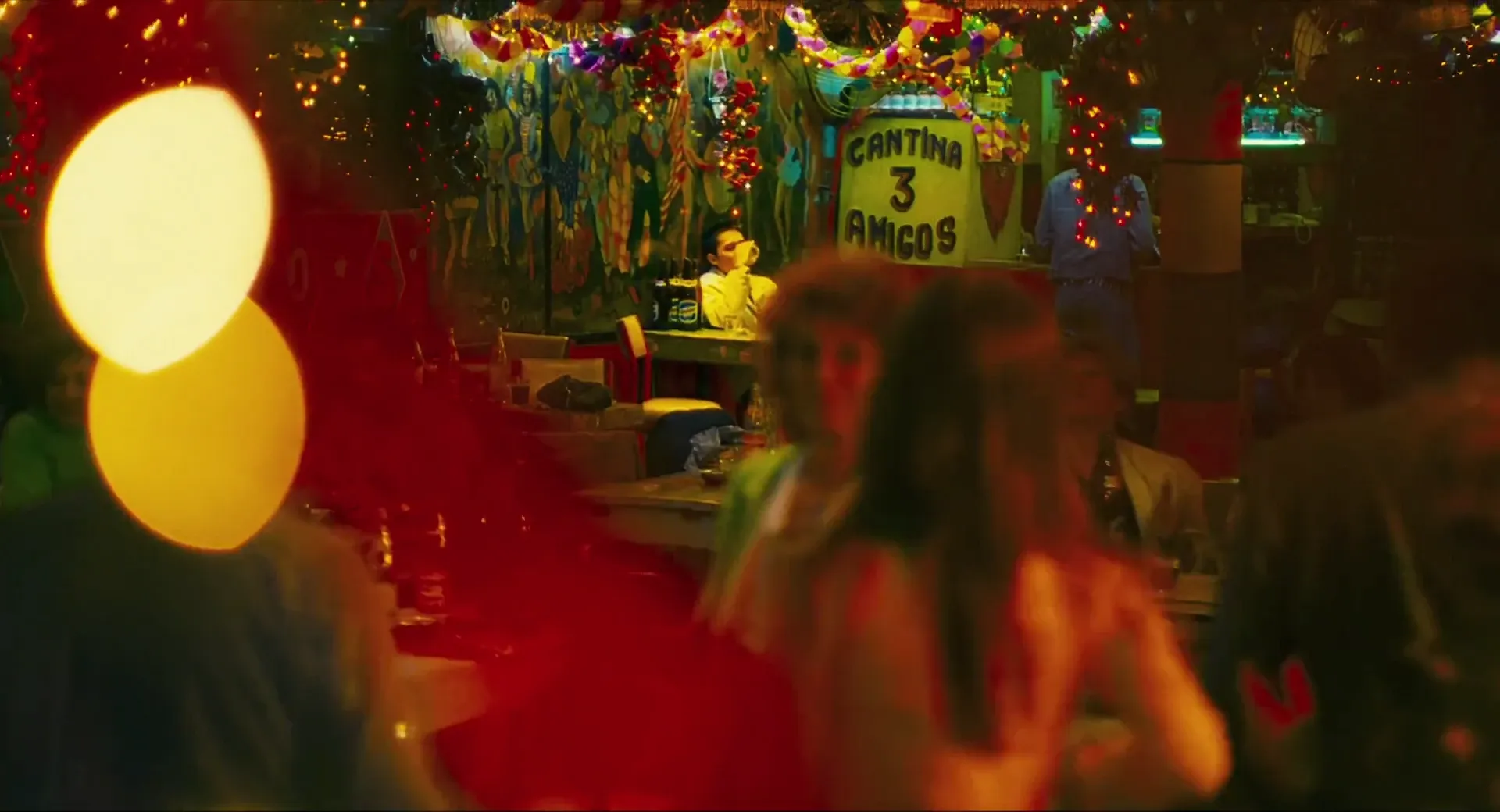
This is where he sits in the same conversation as Vittorio Storaro and the idea that color is a language — except Doyle rarely pre-plans the sentence. He reacts to whatever the location is already doing and pushes it past comfortable. A grimy stairwell isn't a problem to light around; it's a palette.
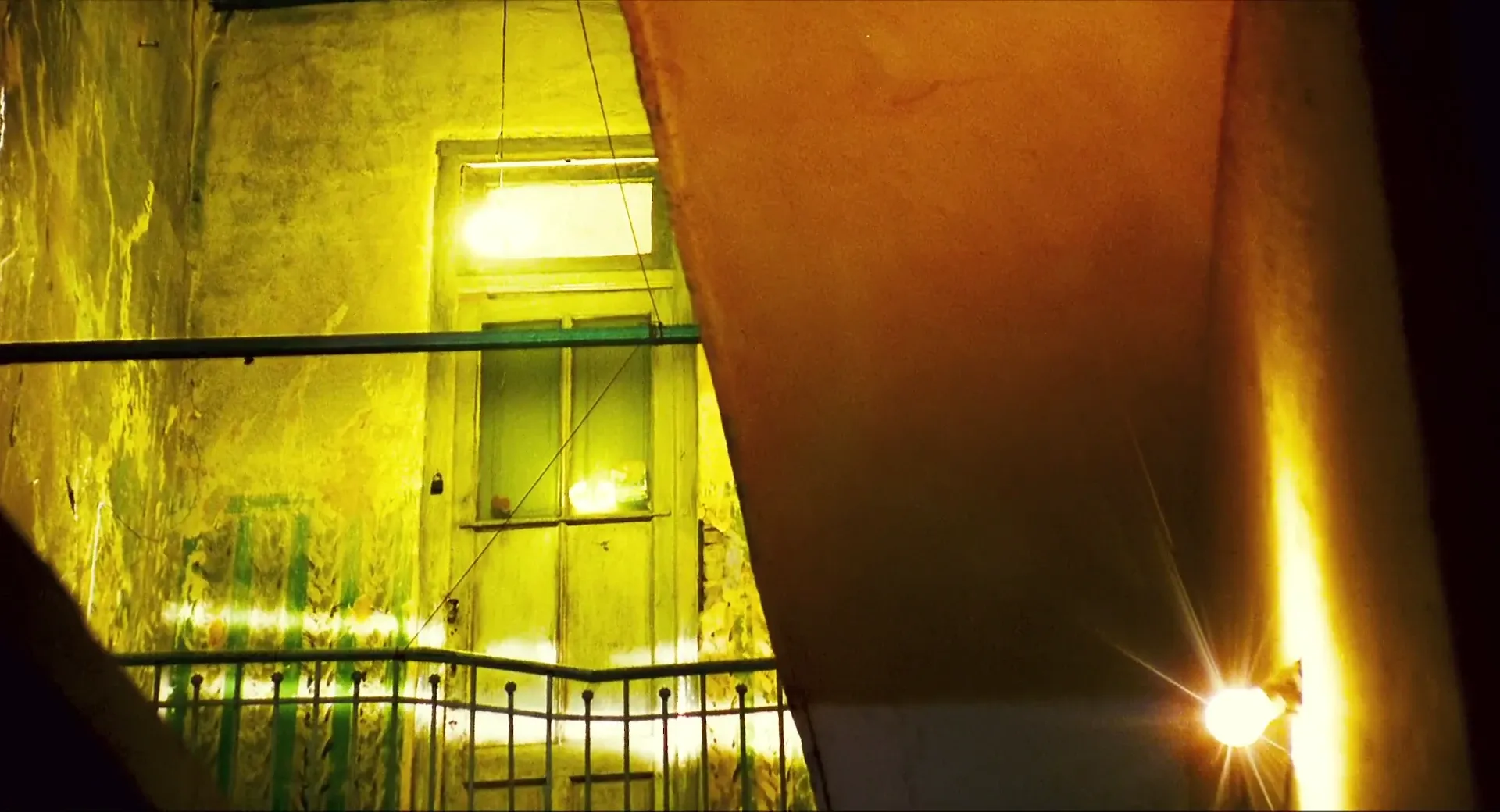
The trick most imitators miss is that the color always has a source you can point to — a sign, a bulb, a window. It reads as heightened, not fake, because the light is motivated even when the grade is extreme. If you want to see the restrained end of that same instinct, it's worth studying the case for shooting in shadow and underexposure next to Doyle's maximalism — same respect for available light, opposite volume.
Handheld and the geography of longing
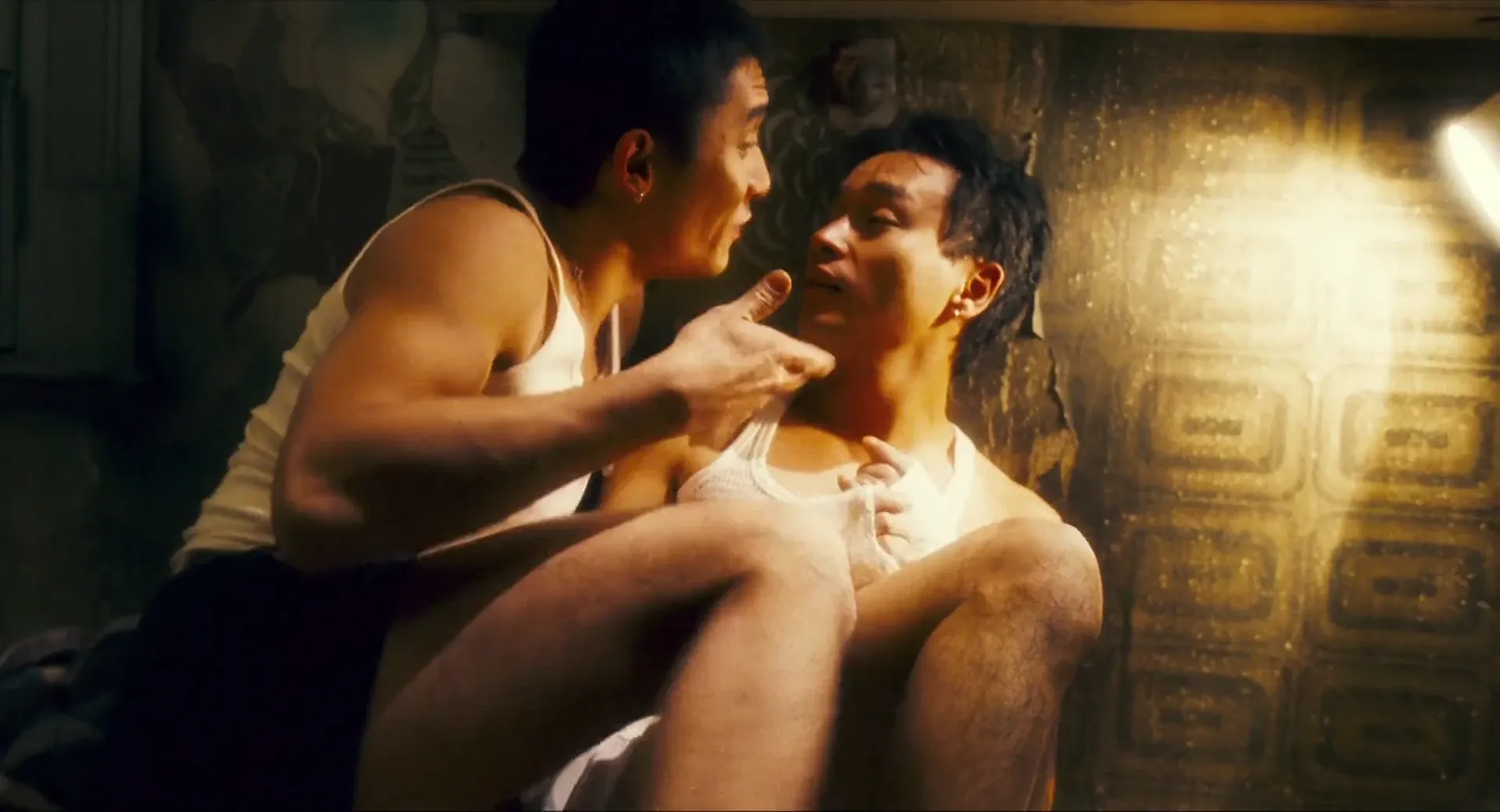
Happy Together moved the whole aesthetic to Buenos Aires, as far from Hong Kong as Wong could get, and it earned him the Best Director prize at Cannes in 1997. Doyle's camera there is mostly handheld and unafraid of a rough, grainy image — it drifts, it crowds the actors, it lets a room feel lived-in and claustrophobic at the same time.
Look at how close he sits to Tony Leung and Leslie Cheung in a frame like this. There's no clean master, no polite distance. The handheld frame puts you inside the argument instead of watching it from across the room, and the warm, textured wall behind them does half the emotional work. It's the opposite of a locked-off, composed frame — and it's exactly why the intimacy reads.
When the frame is the whole point
By In the Mood for Love, the restlessness had cooled into something almost unbearably precise — slow, formal compositions shot partly through doorways and mirrors, with the two leads endlessly framed apart. Doyle shot it alongside Mark Lee Ping-bin, stepping away partway through when the famously long production ran past his other commitments. The film took the Grand Prize of the Technical Commission at Cannes in 2000, shared by Doyle, Mark Lee, and editor-designer William Chang — recognition that the look and the cut were inseparable.
That's the throughline across all of it. Doyle never treated the frame as a container for the story; the frame was the story. The smear, the bent wide lens, the overheated color, the handheld drift — none of it is style for its own sake. Each choice is doing emotional work the dialogue never has to.
Which is the real lesson for anyone building a look today: the reason a Doyle frame keeps ending up on mood boards isn't the technique, it's the intent behind it. The fastest way to learn that is to stop scrolling loose screenshots and actually build a proper visual reference library — frames organized by the feeling you're chasing, tagged so you can find the exact one when the director asks "more like this." That's what StillsLab is for: pulling a Doyle frame, or a Deakins frame, or your own reference, and putting it next to the shot on your list where it can actually change a decision.
How did you like this article?
Login to react to this article
Discussion (0)
💬 No comments yet. Be the first to share your thoughts!