Mad Max: Fury Road — Center-Framing Chaos You Can Actually Follow
George Miller gave his operators one rule — put the important thing dead center and never let it move. It's why the chaos never loses you.

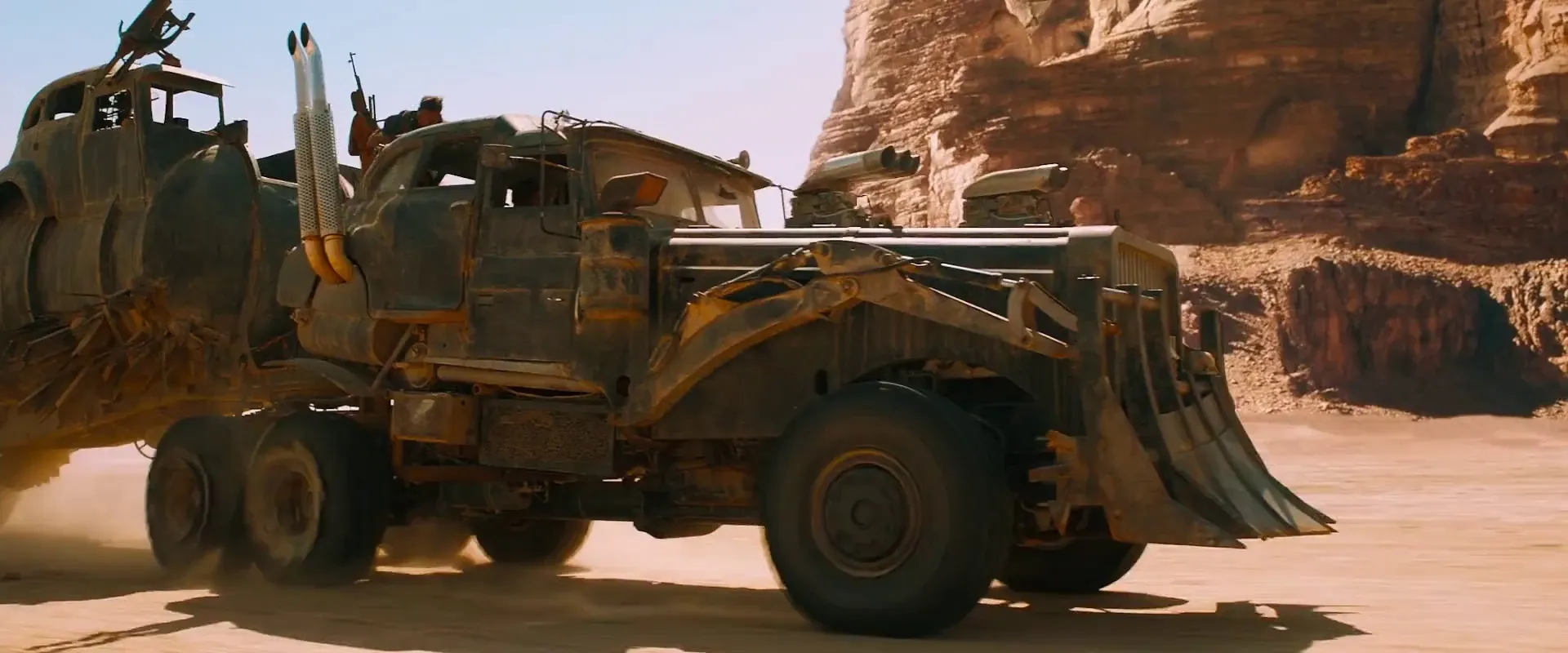
Most action films lose you in the cut. Two cars collide, a body flies, and by the third edit you've stopped tracking who's where and started just absorbing noise. George Miller built the entire visual grammar of Mad Max: Fury Road to solve that exact problem — and the fix was almost embarrassingly simple.
Put the important thing in the middle of the frame. Keep it there. Cut on it.
That one rule is why a film cut from roughly 2,700 individual shots, most of them moving vehicles at speed, never once feels like chaos you can't follow. John Seale, who came out of a five-year retirement to shoot it, and Miller turned a sustained two-hour car chase into something legible. Understanding how they did it is a masterclass in the difference between busy and confusing.
The center-frame rule, and why it broke every operator's habit
Miller gave his camera operators an instruction that went against everything they'd trained for: put the point of interest dead center, and don't worry about what's happening at the edges. Operators who'd spent careers composing for the wide anamorphic frame — balancing subjects along the thirds, using negative space — found it genuinely hard to do.
The logic is about the cut, not the single shot. When the subject sits in the same central spot from one shot to the next, the viewer's eye never has to travel across the frame to relocate it. Miller has talked about wanting the audience's eye to land in the same place on every cut, so the edits flow instead of jarring. You're not re-scanning the composition three times a second. You lock onto the center and the film does the rest.
That's the trick behind editor Margaret Sixel's work — she won the Academy Award for cutting this film, and Seale earned an Oscar nomination for shooting it. A cut rate that fast should be incoherent. It reads clean because the eye never leaves the middle.
Controlled chaos: the eye stays locked while everything else explodes
Center-framing is what lets Miller pack the edges with mayhem without losing you. Look at how a stunt reads when the shooter stays centered:

The rider and the bike are a blur of motion at the top of the frame — deliberate, in-camera, exactly the kind of movement a still can't fake. But your eye isn't chasing them. It's anchored on the figure planted in the center. The blur becomes texture around a stable point of attention rather than the thing you're straining to track. That's the whole design: maximum energy at the edges, absolute clarity at the core.
The daylight grade: saturated on purpose, never messy
The other half of the legibility problem is color. A muddy, naturalistic desert would turn every wide shot into visual soup. Instead the film pushes its palette hard — the sand and rock are cranked toward a hot, saturated amber, and the whole daytime world reads like a single deliberate poster color.
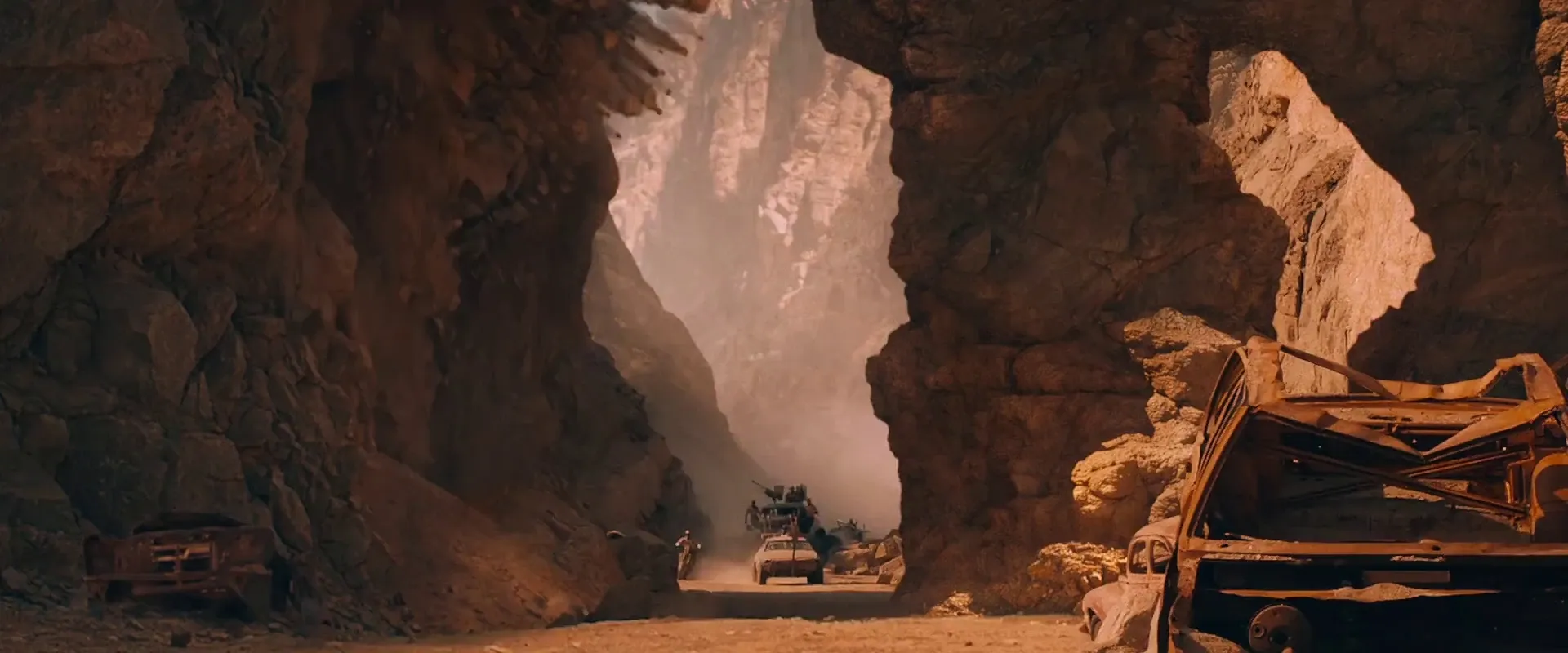
This is where saturation works for clarity instead of against it. When the background is one unified color field, the eye separates figure from ground instantly. The vehicles read as dark shapes against a wall of amber. Nothing competes. It's the opposite of the desaturated realism most action films reach for, and it's a big reason the frame stays readable even when it's packed.
Day-for-night: two stops over, then graded down
The night sequences use the same discipline in reverse. Rather than shoot in the dark, Seale exposed the day-for-night material roughly two stops over, protecting the highlights, then the colorist pulled it back down and pushed it deep into a cold, near-monochrome blue in the grade.
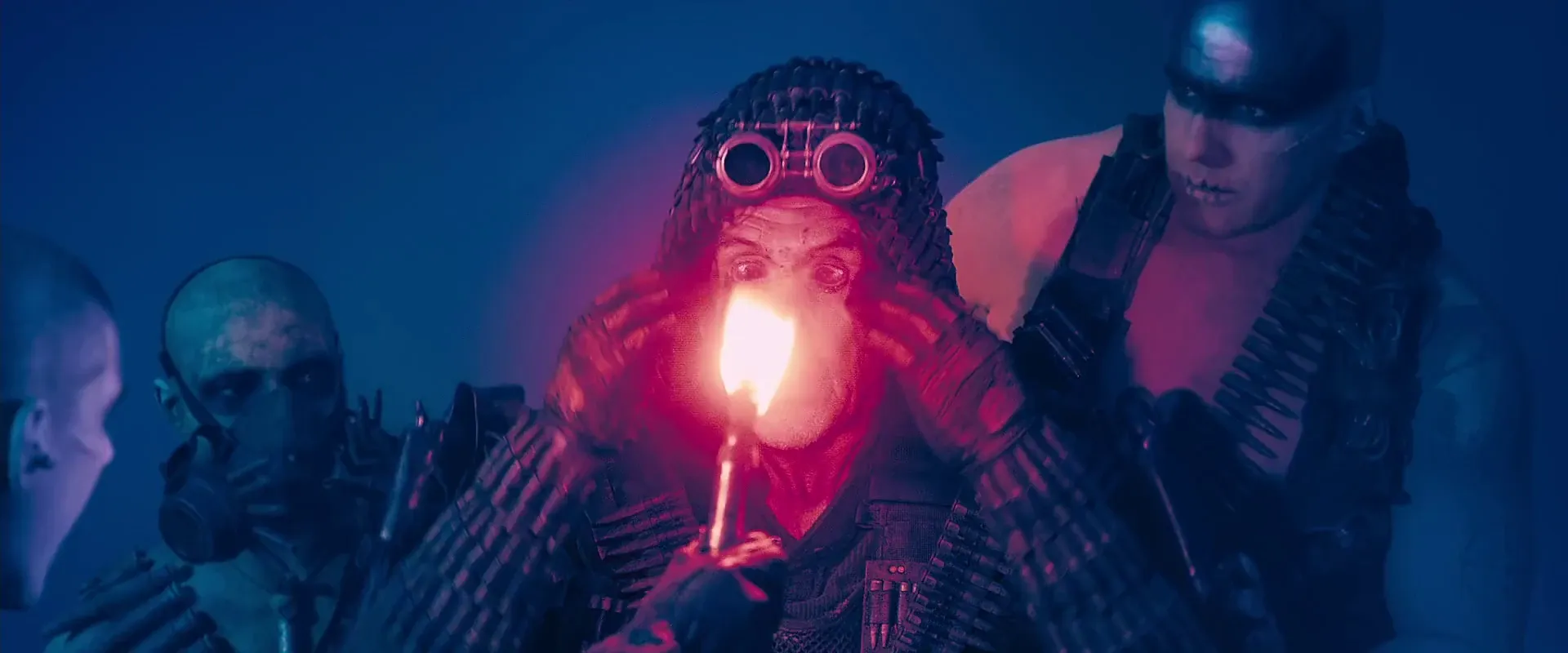
The result is a two-color world — amber days, teal-blue nights — that behaves like a comic panel. Within the blue, a single warm source (a flare, a torch, a face) pops as the point of interest. Same principle as the center-framing: strip the frame down to one thing the eye is meant to find, then make finding it effortless. The saturation isn't decoration. It's navigation.
What this means when you're planning your own coverage
You don't need six ARRI Alexas and a fleet of war rigs to steal from this. The lesson scales down: decide what the eye should find in every shot, keep that decision consistent across your coverage, and let the grade reinforce it instead of fighting it. Legibility is a plan you make in prep, not something you rescue in the edit.
That planning is easier when your references live next to your shotlist instead of in a scattered folder. Pulling frames like these into a shot breakdown — tagging the center-frame logic, the palette, the eye-line you want to hold across a cut — is exactly what a connected StillsLab reference gallery is built for. Study how the masters kept the eye locked, then build your own coverage to do the same.
How did you like this article?
Login to react to this article
Discussion (0)
💬 No comments yet. Be the first to share your thoughts!